

A private security guard working at the Jefferson Park CTA Terminal, 4917 N. Milwaukee Ave., reportedly returned fire after a group of three people started harassing him and then fired read story
Chicago City Council approves extra $70 million in funds for migrants, as some NW Side aldermen object
by BRIAN NADIG
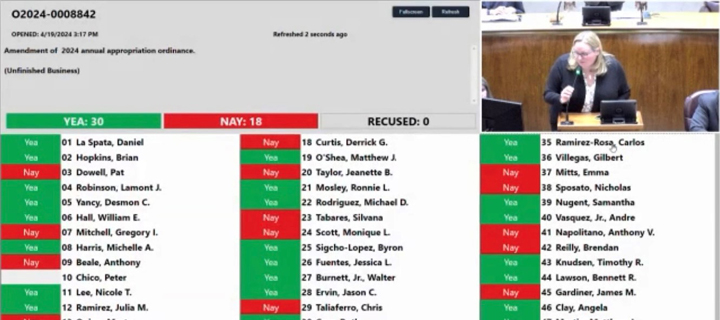
Despite opposition from several local alderpersons, the City Council on April 19 approved proposals for an additional $70 million in funding to address the migrant crisis and for a $1.25 billion bond issuance for community improvements — a plan that some criticized for its lack of transparency.
“Who’s getting the money? It ain’t Chicagoans and it ain’t the migrants,” Alderman James Gardiner (45th) said of the migrant funding.
Gardiner added, “The only ones eating are the ones with the contracts (and) they’re eating at an all-you-can-eat buffet.”
”Come October we’ll be asking for another property tax increase,” Gardiner said.
He said that the funds could be used to help Black and Brown communities, improve parks and provide more assistance to struggling veterans.
The city is “nearing $1 billion” in spending on the crisis if city, county, state and federal dollars are all taken into account, Gardiner said.
Some alderpersons have argued that the funding is needed given the anticipated increase in new arrivals this summer as Chicago hosts the Democratic National Convention and some called for more efforts to reduce the time it takes migrants to get work permits so that they can get jobs and start paying taxes.
The migrant funding, which will come from the city’s reserves, was approved by a vote of 30 to 18.
Area alderpersons voting against the measure included Gardiner, Nicholas Sposato (38th), Anthony Napolitano (41st) and Chris Taliaferro (29th).
In support were Ruth Cruz (30th), Carlos Ramirez-Rosa (35th), Gilbert Villegas (36th), Samantha Nugent (39th), Andre Vasquez Jr. (40th) and Debra Silverstein (50th). Not casting a vote during the meeting was Rossana Rodriguez-Sanchez (33rd).
The bond proposal was approved by a vote of 32 to 17, with Villegas, Sposato, Nugent, Gardiner, Napolitano and Silverstein among those voting against it.
Under the plan, projects under $5 million funded through the program would not have to come before the council for approval of the expenditure. Some alderpersons called for that threshold to be lowered to $2.5 million or $1 million, but attempts to amend the proposal failed.
Nugent said that she likes the concept of the development funding plan, “especially since it doesn’t raise taxes,” but that she is a “no” vote because the $5 million “threshold is too high (and) there is not enough transparency.”
The city plans to use unused funds from expiring tax increment financing districts to cover the debt incurred from the borrowing (bond issuance) to pay for the program.
Alderwoman Maria Hadden (49th) said that parts of the city, including communities in her ward, don’t have TIF districts, making it more difficult to get the money needed for park improvements and other local infrastructure projects.
“I’m excited that communities like Rogers Park, like Englewood … other parts of the city who don’t have development tools are finally going to get some attention,” Hadden said.
"These bond proceeds will provide the city with much-needed resources to invest in our neighborhoods,” Mayor Brandon Johnson said earlier this year. “This new direction will allow for greater flexibility than the city’s Tax Increment Financing Program and provide critical assistance for new businesses, restaurants, affordable homes and cultural facilities where they’re needed most — not just where there’s a healthy TIF district.”
The Housing and Economic Development Bond will provide $250 million for community improvements throughout Chicago every year for five years (2024-2028), according to the mayor’s office. The city Department of Housing and the city Department of Planning and Development will utilize the proceeds with fewer limitations involving geographic boundaries, eligible costs and market-driven variables that decrease the effectiveness of TIFs in depopulated and disinvested neighborhoods, according to the mayor.
“The expiration of one third of the city’s 121 designated TIF districts over the next three years underscores the need for a new, more effective source of public financing,” said DPD Commissioner Ciere Boatright.
“The TIF expirations create an unprecedented opportunity to restructure city funding with more equitable methods like the $1.25 billion Housing and Economic Development Bond,” Commissioner Boatright said, referencing the public support needed to complete major private investment projects on the West and South sides. “As a more flexible form of financing, the bond will add to our existing tools to support a broader range of projects and better meet the unique needs of our Chicago neighborhoods.”
“With the dependence on TIF, the Housing Department struggled to fund major projects that weren’t within a healthy TIF district,”Housing Commissioner Lissette Castañeda said. “The bond proceeds will provide a more strategic approach and expand the geography where we can provide critical funding assistance.”
DOH would use $625 million of bond proceeds to provide approximately:
- $360-390 million for the construction and preservation of affordable rental homes.
- $210-240 million for the construction and preservation of homeownership, or affordable owner-occupied housing.
- $20-30 million for the preservation of single-room occupancy structures.
DPD would use $625 million of bond proceeds to provide approximately:
- $400-500 million for neighborhood development grants.
- $80-115 million for small business support.
- $55-90 million for jobs and wealth building, including workforce training and missing middle housing infill development.
Bond proceeds will be received by the city upon their purchase by municipal bond buyers. Principal and interest costs, estimated at $2.4 billion over the next 37 years would be fully paid for by projected increases in citywide tax revenues due to expiring TIF districts, according to the mayor’s office.
Bond oversight and monitoring would be administered by DPD and DOH with regular reporting to City Council and the public, including redevelopment agreement requirements involving job creation and retention; local, women and minority hiring; housing affordability provisions and tenancy; public benefits, and other factors.
Bond-related funding is an alternative to the city’s routine approach to TIF district expirations after 24 years. Of the 72 expirations that have occurred since 2008, 34 districts were extended for an additional 12 years.
The city initiated TIF districts in 1984 through a state statute that enables municipalities to allocate all new property tax growth – or increment – within a designated district toward improvement projects within its boundaries. In Chicago, TIF is generally used for the construction and rehabilitation of affordable homes, public infrastructure, capital investments performed by Chicago Public Schools and the Chicago Park District, and select costs involving economic development projects, among other uses.
At the end of a TIF district’s term, its tax levies are redistributed, usually at a much higher level, to all the public agencies that levy taxes. Chicago Public Schools, for example, will realize $56 million in new tax revenues from expiring TIF districts in 2025, increasing to approximately $150 million in 2029.
The bond proceeds could be allocated for neighborhood development projects starting later this year, the mayor’s office said.
On a side note, about 25 years ago a city planning official said that the city was becoming “TIFs R Us,” with adjoining neighborhoods having TIF districts so that one community could borrow from another TIF district, as some districts may be underfunded due to insufficient increases in property values. The Jefferson Park TIF, now expired, had this problem for years.


- Police search for reported suspects after exchange of gunfire between group and security guard working at Jefferson Park CTA terminal
 A private security guard working at the Jefferson Park CTA Terminal, 4917 N. Milwaukee Ave., reportedly returned fire after a group of three people started harassing him and then fired their guns toward him during an incident at about 5:15 a.m. Saturday, Aug. 15, according to Chicago police. Officers reported finding 23 shell casings and
 - Man stabbed on CTA Blue Line near Harlem Ave.; suspects arrested in connection with car break-in on Victoria; man steals from car at gas station in Forest Glen
 A man was stabbed in his hand at about 4:50 a.m. Monday, Aug. 10, on a CTA Blue Line train near the Harlem station, 5550 N. Harlem Ave., after a man with a knife allegedly stole his belongings and attacked him, according to 16th (Jefferson Park) District police. The 31-year-old man reported that he was
 - 45th Ward Dems endorse S Gronkiewicz-Doran for alderperson
 by BRIAN NADIG 45th Ward Democratic Committeeperson Michael Rabbitt and his Dems 45 organization have endorsed Jefferson Park resident S Gronkiewicz-Doran in the ward’s aldermanic race, which will be held on Feb. 23, 2027. Incumbent Alderman James Gardiner, who is on leave from his firefighting job while he serves on the City Council, is seeking
 - New business in the works for former CVS site at Milwaukee & Lawrence in Jefferson Park
 by BRIAN NADIG A new business, possibly a daycare, is in the works for the former CVS Pharmacy at the southeast corner of Milwaukee and Lawrence avenues. The pharmacy closed in January of 2020, but CVS reportedly continued to pay rent for several years after the store’s closing. The site includes an approximately 10,000-square-foot building
 - Gunfire reported at Jefferson Park CTA Terminal on Saturday morning
 by BRIAN NADIG A possible suspect is in custody after gunfire was reported at or near the Jefferson Park CTA Terminal, 4917 N. Milwaukee Ave., at about 5:20 a.m. Saturday, Aug. 15, according to Chicago police. Officers recovered four shell casings, and detectives are reviewing area surveillance footage, according to police. It’s not clear at
 No Pop-Ups
Weekly Digital Edition
Read every story. Skip every pop-up.
Get the full weekly edition delivered to your inbox — no interruptions, no waiting. Just local news the way it was meant to be read.
Only $19.50/year — less than 38¢ a week
Subscribe Now
This is just part of today’s coverage. Get the full story - every article, every ad, every page. Subscribe now.
The Latest From Our Community
A man was stabbed in his hand at about 4:50 a.m. Monday, Aug. 10, on a CTA Blue Line train near the Harlem station, 5550 N. Harlem Ave., after a read story
by BRIAN NADIG 45th Ward Democratic Committeeperson Michael Rabbitt and his Dems 45 organization have endorsed Jefferson Park resident S Gronkiewicz-Doran in the ward’s aldermanic race, which will be held read story
by BRIAN NADIG A new business, possibly a daycare, is in the works for the former CVS Pharmacy at the southeast corner of Milwaukee and Lawrence avenues. The pharmacy closed read story
by BRIAN NADIG A possible suspect is in custody after gunfire was reported at or near the Jefferson Park CTA Terminal, 4917 N. Milwaukee Ave., at about 5:20 a.m. Saturday, read story
by BRIAN NADIG A luxury hotel and spa for cats is planned for a vacant one-story office building at 5510 W. Montrose Ave. in the Jefferson-Portage Park area. Local resident read story
Browse by Category


 No Pop-Ups
Weekly Digital Edition
Read every story.
Skip every pop-up.
No pop-up ads — ever. Just stories, the way they were meant to be read
Full weekly edition delivered to your inbox every week — no waiting, no missing issues
Support local journalism and help keep our community connected
Only $19.50/year
That's less than 38¢ a week
Purchase Digital Subscription
Paypal
$19.50
/year
You can submit your payment via Paypal with a Credit Card. You DO NOT NEED TO HAVE A PAYPAL ACCOUNT.. Just click the “Paypal Subscribe” button below to iniate your secure payment! You will be directed to a Secure Paypal page in which you can pay with a Paypal account if you have one, or you can select "Pay with Debit or Credit Cardt" option below and process your payment via credit card.
Venmo
$19.50
/year
You can submit payment of $19.50 for a 1 year subscription to Nadig Newspapers' Venmo account using this link. Please include the email address in the comment/note section that you would like the digital subscription sent to.