
Six motor vehicle thefts were reported in the area between about midnight Thursday, Sept. 10, and about 7:10 a.m. Saturday, Sept. 19, according to 16th (Jefferson Park) District police. The read story
A look back at Prussing School’s history, as its PTO plans 99th year celebration
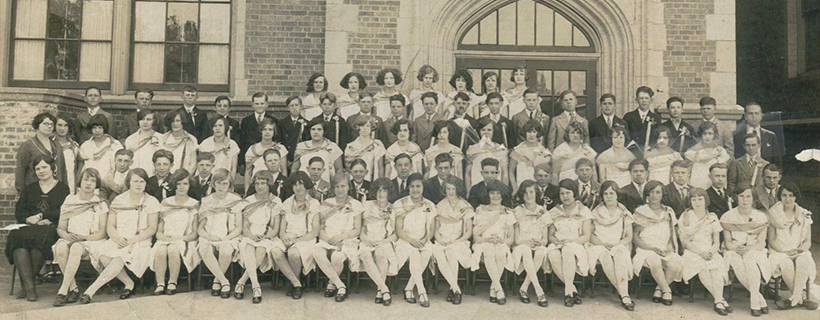
Editor’s note: Nadig Newspapers is taking a look at Prussing School’s history. The history was compiled by former principal Robert Burres and others and is at http://prussing.cps.edu/school-history.html
by BRIAN NADIG
Prussing School in Jefferson Park is about to hold its 99th anniversary bash, as it starts to prepare for its centennial.
The Prussing School PTO will hold a “Let’s Party Like It’s ‘99” fund-raiser from 6 to 9 p.m. Friday, May 15, at Legno Chicago, 4250 N. Central Ave. Tickets cost $65 ($75 at the door), which include open bar and dinner. Visit the PTO’s Facebook page for more info. Proceeds will be used to purchase flex seating that can be used in a variety of classroom settings.
Now its history …
Prussing, 4650 N. Menard Ave., has a strong enrollment today but it still needs its modular units to accommodate demand despite an addition and other improvements built in 2018 as part of then-mayor Rahm Emanuel’s $36 million effort to ease overcrowding in the 45th Ward.
However, the school’s history has often been reflective of the trends and challenges faced by schools in Chicago — and at times the nation.
Enrollment at Prussing peaked soon after it opened and in the 1980s was so low the school almost closed, the Web site states.
Prussing opened in 1927, about a year after Farnsworth and Hitch opened. Another area school, Beaubien, opened in 1905.
In the 1920s school enrollments were booming. “To handle the sudden student population, stove heated portables were erected at three different locations: Central near Lawrence, three portables; Gunnison and Melvina, two portables; Montrose and Melvina, six portables,” an outline of the school’s history states on the site.
Prussing had 800 students when it opened in March of 1927 but 2 years later had 1,800 students as the portable units spread throughout Jefferson Park. The students were primarily German, Scandinavian, Polish and Russian.
The school was named for Ernst Prussing, who came to this country with Carl Schurz, the namesake of Schurz High School. Prussing was a leading figure in civic affairs prior to and after the 1871 Chicago fire, and as a member of the Chicago Board of Education, he helped bring the teaching of German to Chicago schools.
In the 1930s schools reflected the changing social structure caused by unemployment and increased leisure time.
“There was much pride in our city, in the great past that lay behind us, and in the hope for a bright future,” the Prussing Web site states.
And then World War II erupted.
“The war effort was reflected in our school activities of paper and scrap metal drives, and at home by conservation of vital materials and rationing. The Civil Defense was introduced and brothers and sisters were off to war in areas all over the globe. A large plaque in the school lists the names of Prussing graduates who served their country in the Armed Forces.
“Meanwhile, the philosophy of John Dewey began to take hold in our schools. Emphasis was placed on teaching the whole child, considering his interest and abilities, and allowing for individual differences, (and) the social sciences became geared to teach understanding for other cultures, and the United Nations became the new forum for international debate and, hopefully, peace,” the Web site states.
The 1960s brought civil unrest to the country, and educators at Prussing had to deal with changing attitudes of young people and their customs, including musical tends which conflicted with their parents’ radio station preference.
However, the 1980s may have been the most challenging for Prussing.
Enrollment took a dramatic hit due to “white flight,” as Northwest Side families moved to the suburbs or enrolled their children in private schools.
Desegregation plans were discussed, and the uncertainty and other concerns over how the consent decree would be implemented left many area public schools in disarray. Schools had to share principals and building renovations often were delayed.
Some of Prussing’s teachers were transferred to other schools, and there were reports that Prussing itself would be closed, and its students bused to schools in Logan Square a Portage Park.
The school stayed open, but concerns continued.
“Desegregation plans (in 1981-82) struck again. This created fear of no neighborhood school. Also a further neglected building left to rot, boarded up, wasted. Our enrollment sank further. We had only 12 children in half-day kindergarten.
“Consequently we were on the list to be closed again. In order to prove our worth, the Parent Teacher Organization’ parents, teachers, students, and neighbors banded together to keep our building, in dire need of repairs, open. Letters, petitions signed on street corners, yellow ribbons strung on trees, phone calls, telegraphs and unending personal appearances at meetings were all used to convince the powers that be to keep Prussing open.
“Finally as a last resort, we provided proof of the birth rate of the community as the prime reason to retain our neighborhood school, apparently provided someone with enough reason to keep Prussing open,” the Web site states.
Multiple citywide teacher strikes also proved challenging for Prussing, but the school got some welcome news by the late 1980s.
Long-delayed renovations were set to be made, and the school’s enrollment began to rise, as gifted and special education programs were added to the school’s curriculum.
As it prepares to celebrate its centennial, Prussing is ready to party and reflect on its rich history. Most recently, its original auditorium seats were replaced.
But it took 98 years for that to happen.
 No Pop-Ups
Weekly Digital Edition
Read every story. Skip every pop-up.
Get the full weekly edition delivered to your inbox — no interruptions, no waiting. Just local news the way it was meant to be read.
Only $19.50/year — less than 38¢ a week
Subscribe Now
This is just part of today’s coverage. Get the full story - every article, every ad, every page. Subscribe now.
The Latest From Our Community
by CYRYL JAKUBOWSKI A thief caused several hundred dollars in damage while stealing $40 in cash from Sauganash Grill, 6005 N. Sauganash Ave., Thursday morning, Sept. 17, and the same read story
by BRIAN NADIG A parole check at a Big Oaks area home near Normandy Avenue and Argyle Street in August resulted in the recovery of suspected drugs, a gun and read story
by BRIAN NADIG The construction of the new Pollyanna Brewing Company & Distilling in the former Alarmist Brewing at 4055 W. Peterson Ave. in Sauganash is expected to start this read story
A man reported that three men robbed him at about 2:30 a.m. Thursday, Sept. 10, in the 3100 block of West Irving Park Road, according to 17th (Albany Park) District read story
Todd C. Smith, Special Agent in Charge of the U.S. Drug Enforcement Administration Chicago Field Division, recently announced drug-related charges filed with the Cook County State's Attorney's Office against two read story
Browse by Category


 No Pop-Ups
Weekly Digital Edition
Read every story.
Skip every pop-up.
No pop-up ads — ever. Just stories, the way they were meant to be read
Full weekly edition delivered to your inbox every week — no waiting, no missing issues
Support local journalism and help keep our community connected
Only $19.50/year
That's less than 38¢ a week
Purchase Digital Subscription
Paypal
$19.50
/year
You can submit your payment via Paypal with a Credit Card. You DO NOT NEED TO HAVE A PAYPAL ACCOUNT.. Just click the “Paypal Subscribe” button below to iniate your secure payment! You will be directed to a Secure Paypal page in which you can pay with a Paypal account if you have one, or you can select "Pay with Debit or Credit Cardt" option below and process your payment via credit card.
Venmo
$19.50
/year
You can submit payment of $19.50 for a 1 year subscription to Nadig Newspapers' Venmo account using this link. Please include the email address in the comment/note section that you would like the digital subscription sent to.